Every parent knows the golden rule of gift-giving: The expensive toy you bought will be ignored within 15 minutes, but the box it came in will provide entertainment for three days.
Instead of fighting it, lean into it. That pile of Amazon boxes by the door isn’t recycling waiting to happen; it’s a zero cost STEM activity lab waiting to be deployed.
You don’t need to be an engineer to teach preschool physics concepts. You just need some trash and a little imagination. By using cardboard boxes for sensory play and experimentation, you are secretly teaching them about gravity, friction, and structural integrity. They think they are just making a mess; you know you are sneaking in some fun dad science lessons.
Here are 5 cardboard box activities that turn your recycling pile into a physics lab.
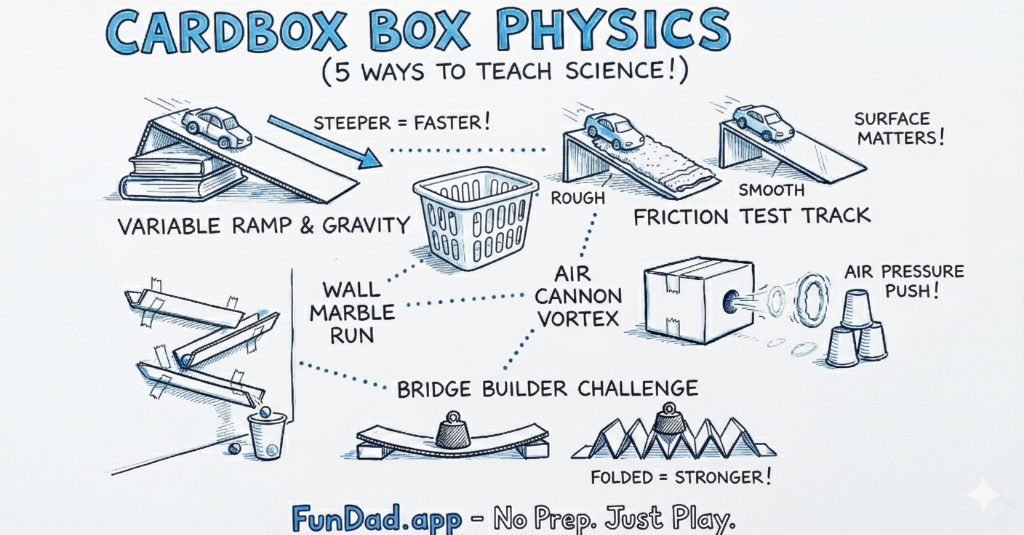
1. The Variable Ramp
The Gist: A classic lesson in exploring slopes and angles and teaching gravity to toddlers. Steeper equals faster.
The Setup: You need one long, flat piece of cardboard (cut the side off a large box) and a stack of books.
How to Play: Prop one end of the cardboard up on a single book to create a gentle slope. Roll a toy car down it. Now, add three more books to make the slope steeper. Roll the same car. Ask, “Which one went faster? Why?”
Pro Tip: Use painters tape to mark on the floor how far the car traveled at different heights. This turns playtime into data collection.
2. The Friction Test Track
The Gist: An easy friction experiment for kids. Why do some things slide and some things stick?
The Setup: Use the same ramp from Activity #1. You also need a small towel, some bubble wrap, or sandpaper.
How to Play: Keep the ramp angle the same. First, send a car down plain cardboard. Next, lay the towel over the ramp and send the car down again. It will move much slower. Explain that rough surfaces “grab” the car wheels more than smooth surfaces. This “grabbing” is friction.
Pro Tip: Turn it into a race. Set up two parallel ramps—one smooth cardboard, one covered in bubble wrap. Race two identical cars to see friction in action.
3. The Wall-Mounted Marble Run
The Gist: One of the best toddler engineering projects. It teaches gravity, momentum, and problem-solving when things get stuck.
The Setup: Cut several cardboard boxes into long strips. Fold them into “V” or “U” channels. You’ll also need painter’s tape and a blank wall (or the side of a refrigerator).
How to Play: Tape the channels to the wall at angles, creating a zig-zag path downwards. The goal is to drop a marble (or a small ball for younger toddlers) at the top and have it make it all the way to a cup at the bottom without flying off the track.
Pro Tip: Let them build it. When the marble flies off the track, don’t fix it for them. Ask, “Uh oh, gravity pulled it off the edge! How can we build a wall to keep it in?“
4. The Air Cannon Vortex
The Gist: A demonstration of air pressure that feels like a superpower.
The Setup: A medium-sized, perfectly sealed box (tape up all the seams). Cut a circular hole about 4 inches wide in the center of one side.
How to Play: Stack up a pyramid of light plastic cups a few feet away. Have your child aim the hole at the cups and slap the sides of the box sharply with both hands. An invisible ball of air will shoot out and knock the cups over.
Pro Tip: If you have a fog machine (or someone who vapes), fill the box with a little smoke first. When they slap the box, they’ll see a perfect smoke ring shoot out.
5. The Bridge Builder Challenge
The Gist: A foundational lesson in structural engineering. Why are triangles stronger than flat shapes?
The Setup: Two stacks of books of equal height, separated by about 12 inches. Several flat strips of cardboard, and some “weights” (soup cans or pennies).
How to Play: Place a single flat strip of cardboard across the gap between the books. Ask your child how many cans it can hold before it collapses (it won’t be many). Now, take another strip of cardboard and fold it back and forth like an accordion fan. Place that across the gap. It will hold significantly more weight.
Pro Tip: Explain that folding the cardboard adds “ribs” that help spread the heavy weight out, making the bridge stronger.
Science Class Dismissed
You just spent an hour doing five distinct physics experiments, and it didn’t cost you a dime. That’s the power of object-first play.
If you love the idea of using what you already have to create instant engagement, but hate the brainstorming part, let us handle it.
Download FunDad on the App Store and use our AI to turn your living room clutter into your next adventure.