We spend a lot of time teaching our kids to look and listen. “Look at the red car.” “Listen to the bird.”
But we often ignore the most primal sense of all: Smell.
The nose is a direct line to the brain’s memory center. It’s why the smell of crayons instantly reminds you of kindergarten. Yet, we rarely play sensory games for kids that focus purely on the olfactory.
Today, we change that.
We are playing the Smell Guessing Game. It falls under our Developmental Stealth Mode because while they think it’s a hilarious blindfold sensory challenge, you are actually building neural pathways, expanding vocabulary, and working on sensory awareness development.
Here is how to raid your pantry for an afternoon of kitchen sensory play.
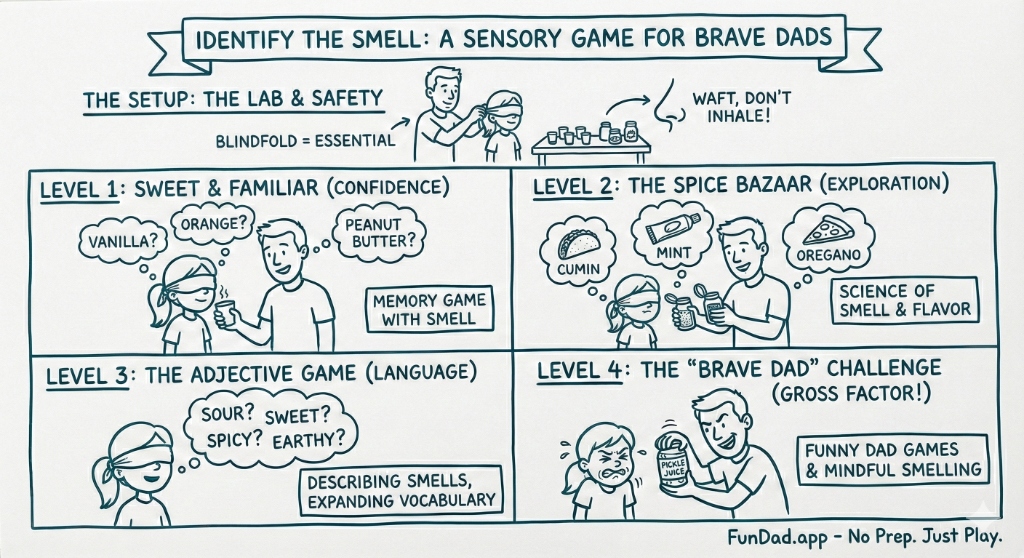
The Setup: The Lab
You don’t need expensive equipment. You need small cups (or just hold the jar) and a blindfold.
- The Safety Rule: Before you start, teach them safe smells for toddlers. Teach them to “waft” the air toward their nose rather than inhaling deeply directly from a bottle. (Note: Only use food-safe items or gentle soaps. No cleaning chemicals).
- The Blindfold: This is essential. It forces the brain to rely solely on the nose, shutting down visual cues. This is a classic trust game for families.
Level 1: The Sweet & Familiar (Confidence Building)
Start with strong, pleasant scents. These are toddler sensory activities that build confidence.
- The Scents: Vanilla extract, a slice of Orange, Peanut Butter (if no allergies), a broken stick of Cinnamon.
- The Game: “Take a sniff. What is it?”
- The Science: This is a memory game with smell. They have to access their database of experiences (“I remember eating an orange”) and link it to the current input.
Level 2: The Spice Bazaar (Exploration)
Now we move to exploring spices with kids. The spice rack is a treasure trove for olfactory sensory activities.
- The Scents: Cumin (smells like tacos?), Mint (smells like toothpaste?), Oregano (smells like pizza?), Coffee grounds.
- The Challenge: These are harder. They might recognize the context (“It smells like dinner!”) before the name.
- The Lesson: This teaches the science of smell for kids—how aroma creates flavor.
Level 3: The Adjective Game (Language)
This is the “Stealth Education” part. We are moving beyond identifying scents to language development describing smells.
- The Rule: They can’t just say “It’s a lemon.” They have to describe the smell.
- The Vocabulary:
- “Is it sour?”
- “Is it sweet?”
- “Is it spicy?”
- “Is it earthy?”
- The Benefit: This connects sensory input to abstract language. It is sophisticated educational sensory games disguised as fun.
Level 4: The “Brave Dad” Challenge (The Twist)
If you want funny dad games, you have to introduce the “Gross Factor.”
- The Scents: A jar of pickle juice (vinegar), a piece of strong cheese, or… (if you are truly brave) a “mystery sock” (clean, hopefully).
- The Reaction: Watching their face scrunch up when they smell vinegar is priceless. It triggers a strong reaction, which is great for mindful smelling—being fully present in the moment (even if that moment smells like pickles).
Why Wake Up the Nose?
Developing 5 senses means not letting any of them atrophy. By focusing on smell, you are opening up a new way for your child to experience the world.
Next time you are outside, play a nature smells activity. Smell the dirt, the rain, the pine needles.
It costs $0. It uses things you already have in the kitchen. And it proves that fun guessing games don’t need a screen—they just need a nose.
Download FunDad on the App Store. Point your camera at your spice rack or fridge, and we will generate a sensory quiz for your kids instantly.