You hear the words “science project” and your Dad-Brain immediately flashes to images of papier-mâché volcanoes exploding red dye onto your beige carpet. You want your kids to learn STEM concepts, but you also want your security deposit back.
Welcome to the “Medium Energy” zone.
This is for the dad who has enough gas in the tank to supervise an activity, but absolutely zero desire to hose down the patio afterward. These are kitchen table science experiments designed for maximum “wow factor” with minimum cleanup.
The secret weapon? A rimmed baking sheet. Do everything inside the tray, and your cleanup time drops from 30 minutes to 30 seconds.
Here are 4 simple kitchen chemistry and physics projects you can knock out in 15 minutes before dinner.
The Golden Rules of Low-Mess Science
- Containment is King: Every experiment happens on a cookie sheet or a large plastic tray.
- Micro-Dosing: We aren’t myth-busting. Use teaspoons of vinegar, not gallons.
- Proximity to Water: Do these at the kitchen table, near the sink.
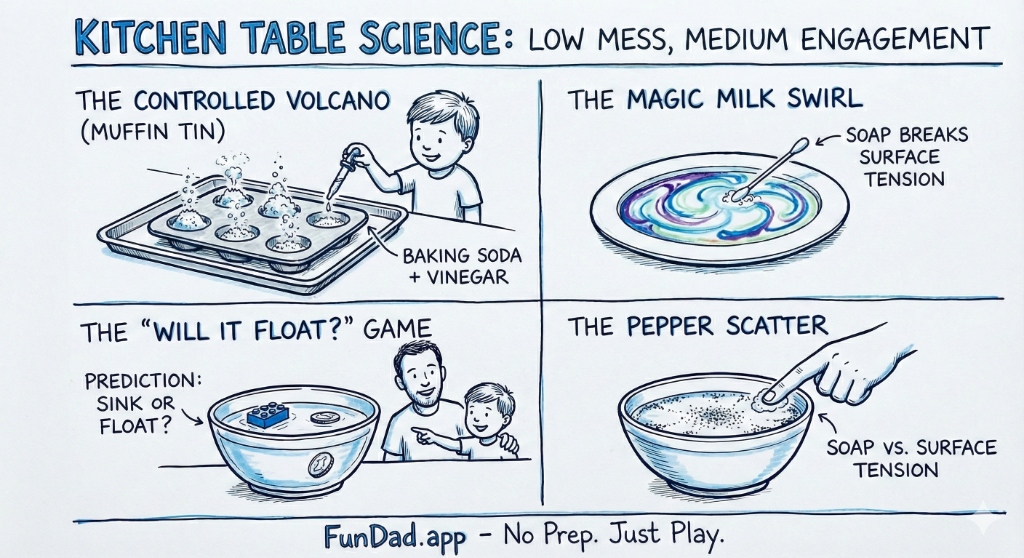
1. The “Controlled” Volcano (Muffin Tin Chemistry)
The Gist: The classic baking soda vinegar experiment, scaled down for indoor use. It’s satisfying fizz without the eruption.
The Setup: Place a muffin tin on your containment cookie sheet. Put a drop of food coloring in each muffin cup. Add a tablespoon of baking soda over the color to hide it. Fill a small cup with vinegar and give your child a medicine dropper or a teaspoon.
The Experiment: Have them drop small amounts of vinegar into each cup to reveal the hidden colors through a fizzy reaction.
The Science: A basic acid-base reaction that creates carbon dioxide gas (the fizz). This is perfect color mixing for toddlers and simple kitchen chemistry for older kids.
2. The Magic Milk Swirl
The Gist: A visually stunning lesson in surface tension that looks like wizardry. One of the best rainy day science projects.
The Setup: Pour enough whole milk into a shallow plate to cover the bottom. Drop 3-4 distinct drops of different food coloring near the center (don’t let them touch yet). Dip a Q-tip in dish soap.
The Experiment: Have your child gently touch the soapy Q-tip to the center of the milk plate. The colors will violently explode outward and swirl for minutes.
The Science: This is a surface tension experiment for kids. Milk has fat and surface tension. The soap breaks the tension and chases the fat globules around, taking the color with it. (Note: Skim milk won’t work well; you need the fat).
3. The “Will it Float?” Prediction Game
The Gist: The ultimate easy STEM activity at home. It builds observation skills for kids and requires almost zero prep.
The Setup: Fill a large mixing bowl or pot with water. Raid the junk drawer for random items: a cork, a coin, a grape, a plastic Lego, a metal spoon.
The Experiment: Before dropping an item in, ask your child to predict: “Sink or float?” Keep a tally of who guesses correctly.
The Science: This floating and sinking experiment teaches density and buoyancy. It’s great for asking “Why?” (Why did the small grape sink but the big Lego float?).
4. The Pepper Scatter
The Gist: A 30-second trick that is great for engaging kids while cooking.
The Setup: Fill a small bowl with water. Sprinkle black pepper over the surface until it’s coated.
The Experiment: Have your child stick a dry finger into the center. Nothing happens. Now, put a dab of dish soap on their finger and have them do it again. The pepper instantly races to the edges of the bowl as if terrified of the soap.
The Science: Another quick lesson in surface tension. The water molecules on top are holding hands tightly (surface tension), supporting the pepper. The soap breaks that hand-holding grip, and as the water pulls back to the edges, it carries the pepper along.
Science Without the Stress
You don’t need a curriculum to teach preschool physics concepts. You just need a kitchen table and a willingness to let them make a very small, contained mess.
These 15 minute science activities are perfect bridging activities—something to do while the pasta boils or when the rain just won’t stop.
If you like the idea of quick, low-mess engagement tailored to your exact energy level, check out FunDad.
Download FunDad on the App Store. Tell us you have “Medium Energy” and “Low Mess Tolerance,” and we’ll generate the perfect activity in seconds.