It is raining. The park is a mud pit. The kids are vibrating with energy, and the walls of the living room are starting to feel very close together.
You need a rollercoaster. You need a bobsled team. You need speed.
But you don’t have snow. You have beige carpet.
Luckily, you also have a plastic laundry basket.
This is laundry basket sledding. It is the pinnacle of active play with household items. To your kids, it is safe indoor thrills. To you, it is a high-intensity interval workout that rivals Crossfit.
Here is how to turn a chore receptacle into a vehicle for friction experiments for kids.
The Vehicle: Choosing Your Sled
Not all baskets are created equal. You need the classic rectangular plastic hamper with the smooth bottom. Wicker is a fire hazard (friction burn). Mesh is too flimsy.
Safety Check: Check the bottom for cracks (plastic sharks). Ensure hands stay inside the vehicle to avoid “carpet burn knuckles.” This is thrill seeking for kids, but we want to keep the skin on their fingers.
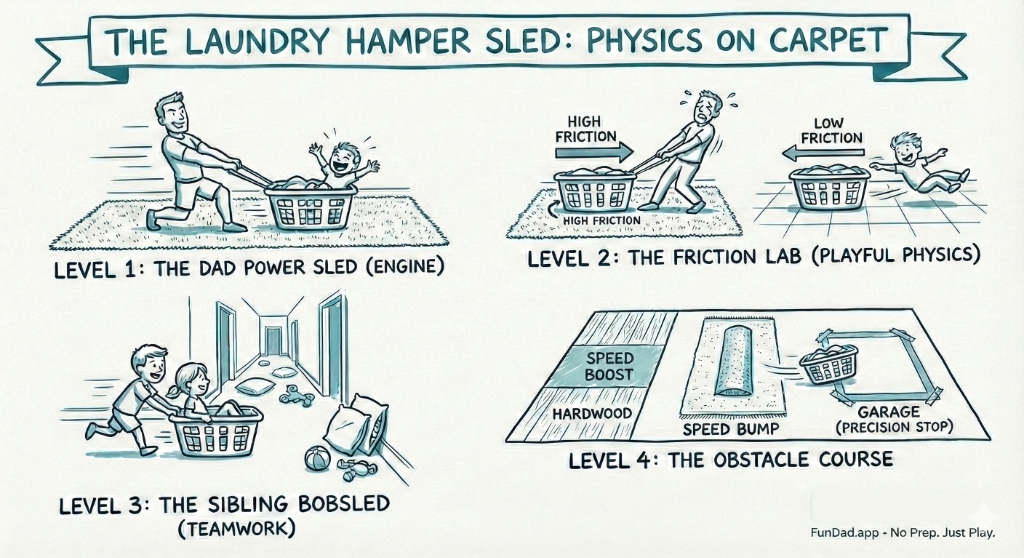
Level 1: The Dad Power Sled (The Engine)
This is the most basic form of laundry basket rides. It is pure gross motor indoor fun—mostly for you.
- The Setup: Kid sits in the basket. You grab the front rim (or tie a robe belt to the handle for a tow rope).
- The Action: You run. You drag. You spin.
- The “Why”: This provides massive input to their vestibular system activities (balance and motion). The rapid acceleration and spinning help regulate their sensory needs. It is the ultimate energy burner for toddlers—and a back workout for Dad.
Level 2: The Friction Lab (Playful Physics)
Now, we stop running and start thinking. We are going to turn carpet sliding games into physics for toddlers.
- The Experiment: “Why is it hard to pull you on the rug, but easy on the kitchen floor?”
- The Lesson: Explain friction. The carpet grabs the basket (high friction). The tile lets it slide (low friction).
- The Variable: Add weight. Put a second kid (or a pile of books) in the basket. “Is it harder to push now?” This connects mass to force. You are doing playful physics lessons without a textbook.
Level 3: The Sibling bobsled (Teamwork)
If you have more than one child, this becomes sibling team games.
- The Setup: One kid is the driver (rider). The other is the engine (pusher).
- The Rules: They have to push their sibling from the Sofa to the TV. Then they switch.
- The Benefit: These push and pull games build heavy muscle work. It forces them to communicate (“Steer left!”). It turns adventurous indoor play into a cooperative mission rather than a fight.
Level 4: The Obstacle Course
Transform the living room into a track.
- The Terrain: Going from the carpet to the hardwood is a “Speed Boost.” Going over a throw rug is a “Speed Bump.”
- The Challenge: Can you slide the basket with just enough force to stop exactly in the “garage” (a taped square on the floor)?
- The Skill: This tests force control. Too hard, and they crash into the wall. Too soft, and they stall. It is simple active games meeting precision.
Why It Works
Rainy day physical play usually involves breaking something. But the Laundry Hamper Sled is surprisingly contained.
It satisfies the urge for creative movement games and speed. It transforms the texture of your floor into a playground for exploring surfaces and textures.
And when the game is over? You are already holding the laundry basket. You might as well pick up the stray socks on the floor while you catch your breath.
Download FunDad on the App Store. Point your camera at a laundry basket or a carpeted hallway, and we’ll generate a physics game or obstacle course instantly.