You buy them the expensive plastic shape sorter. They play with it for five minutes. You open your toolbox to fix a loose hinge. They stare at it with the intensity of a diamond thief cracking a safe.
Kids are naturally drawn to “real” things. They want to do what you do. They don’t want the plastic hammer that squeaks; they want the heavy one with the rubber grip.
In the education world, this is called “Practical Life.” In the FunDad Lifestyle, it’s called getting your garage organized while keeping the kid busy.
This is Montessori at home ideas stripped of the pretension. We are taking the sorting activities for toddlers out of the playroom and into the workshop.
Here is how to turn a messy junk drawer or a chaotic toolbox into a goldmine of cognitive sorting games and bonding over tools.
Phase 1: Safety Check (Responsible Risk Taking)
Before we open the latch, we need to talk about tool safety for kids. This teaches responsible risk taking.
- Remove the Sharps: Take out the utility knives, the saws, and the drill bits.
- The Zone: Define the workspace. A low table or a clean patch of floor.
- The Rule: “Tools stay on the mat.”
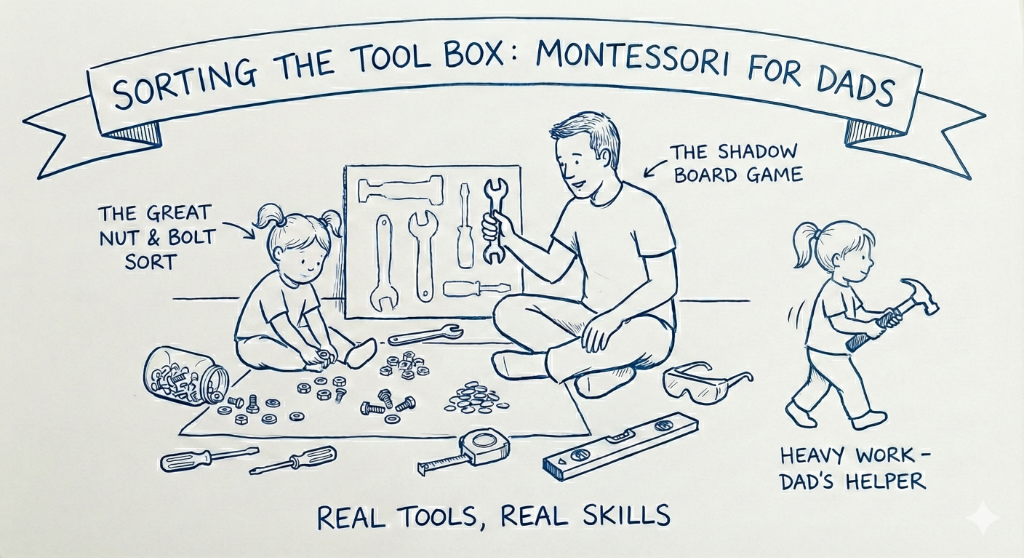
Phase 2: The Great Nut & Bolt Sort
This is the ultimate fine motor skills sorting activity. It beats plastic bears any day because the feedback is metallic, cold, and heavy. This is a real sensory bin hardware style.
- The Setup: Find that jar in your garage. You know the one. It’s full of random screws, washers, nuts, and bolts. Dump a handful onto a tray.
- The Mission: “We need to separate these. Put the washers here, the nuts here, and the screws here.”
- The Skill: This is math skills classification. They are analyzing attributes (round vs. pointy, hole vs. solid) and categorizing objects.
- The Challenge: For older kids, have them screw the matching nut onto the bolt. This is incredible fine motor practice.
Phase 3: The Shadow Board Game
If you have a pegboard, this is easy. If not, grab a piece of cardboard and a marker.
- The Setup: Trace the outlines of a few safe tools (a wrench, a screwdriver, a tape measure, a level).
- The Mission: Learning sizes and shapes. Hand them the tool and ask them to match it to its “shadow.”
- The Vocabulary: This is the perfect time for naming tools for kids. Don’t call it a “twister.” Teach them “Adjustable Wrench.” They love big words.
Phase 4: Heavy Work (The Fetcher)
Toddlers love to carry heavy things. It provides proprioceptive input (body awareness), known in therapy circles as heavy work for toddlers.
- The Mission: Ask them to be dad’s helper. “Can you carry this hammer to the workbench? Use two hands.”
- The Payoff: They feel immensely important. They are engaging in real life practical skills for kids, not just pretending.
Why This Matters
Involving kids in DIY does more than just distract them. It builds confidence.
When a child successfully sorts a pile of messy hardware, they feel they have contributed to the household. They aren’t just playing; they are working. These are useful toddler activities that bridge the gap between “kid world” and “dad world.”
So, next Saturday, don’t shoo them out of the garage. Pull up a stool, dump out the jar of bolts, and let them sort.
Download FunDad on the App Store. Scan your toolbox or a pile of screws, and our AI will suggest safe, age-appropriate games to play with them instantly.