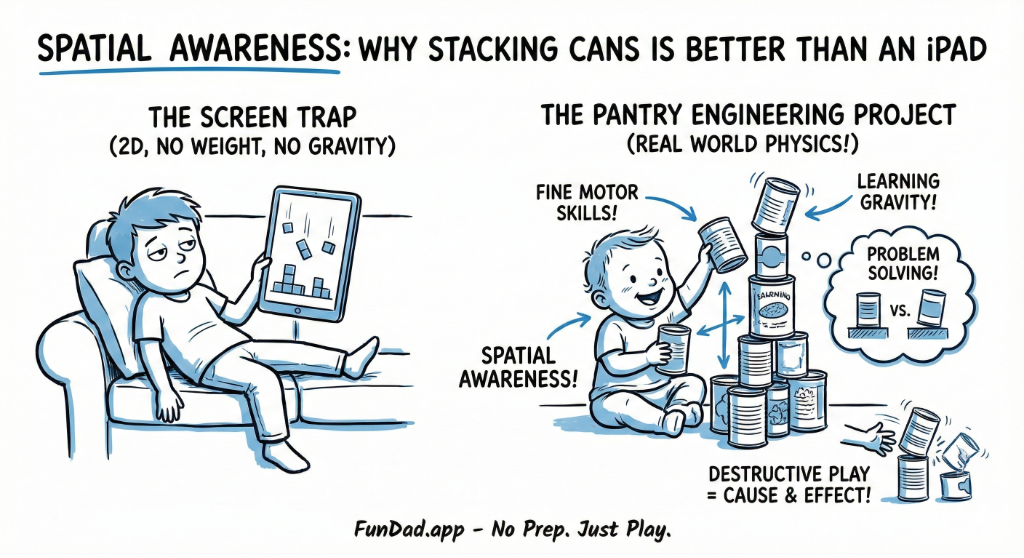
You hand your toddler an iPad. They swipe, tap, and watch colorful blocks tumble down on the screen. It keeps them quiet. It feels educational.
But there is a massive difference between watching physics and feeling physics.
In the digital world, a block always lands perfectly flat. In the real world, if you put a can of peas on top of a can of soup slightly off-center, disaster strikes.
Welcome to Developmental Stealth Mode. We are going to explore why a simple pantry raid is vastly superior to the most expensive tablet for your child’s brain.
This is about spatial awareness activities for toddlers, and why the humble tin can is the ultimate cheap educational toy.
The Problem with the Screen
Screens are 2D. They lack depth, weight, and consequence. When a child plays a stacking game for kids on a tablet, they aren’t learning how objects relate to one another in physical space. They are learning a gesture.
Why physical play is better than screens comes down to sensory feedback. A can has weight. It has a cold metal texture. It makes a noise when it scrapes against another can. This data tells the brain how to navigate the world.
The Pantry Engineering Project
Go to the kitchen. Pull out every can you have—beans, corn, soup, tomato paste.
You have just created a screen free activity for toddlers that rivals any STEM camp.
Here is the science happening while they build a tower:
1. Mastering the “Where Am I?” (Spatial Awareness)
Spatial awareness is the ability to understand where your body is in relation to objects. When your child reaches for a can, their brain is calculating distance, depth, and trajectory.
Building towers with household items forces them to visualize the structure in 3D. They have to rotate the object to make it fit. This builds visual spatial skills that are crucial for math and reading later in life.
2. The Feedback Loop of Gravity
Learning gravity through play is a harsh but effective lesson. On an iPad, the game might not let them make a mistake. In the kitchen, if they put the heavy pumpkin puree on top of the tiny tomato paste, gravity takes over.
This is toddler engineering. They learn that a wide base is stable and a narrow base is tippy. They are solving complex structural problems in real-time. This is the essence of problem solving games for kids.
3. Fine Tuning the Machine (Motor Skills)
Watch their hands. To stack a can successfully, they need fine motor skills stacking. They have to grip the cylinder, lift it (engaging shoulder and arm muscles), and release it gently without knocking the tower over.
This requires immense motor planning and hand eye coordination. They are calibrating the force of their muscles to match the weight of the object. An iPad swipe requires almost zero muscular variation.
The Joy of Destruction
Let’s be honest: The best part of building a tower is knocking it down.
Don’t discourage this. Destructive play benefits are real. It teaches cause and effect. I push -> It falls. It also allows them to experiment with force. How hard do I have to push to knock over the bottom can vs. the top can?
How to execute the “Can Challenge”
Turn this into a game.
The Skyscraper: How high can we go? Try to set a can stacking record.
The Sorting Hat: Group them by size before stacking (this is a secret math lesson).
The Bridge: Can we put two stacks next to each other and put a book across the top?
The Bottom Line
Cognitive development in toddlers doesn’t require batteries. It requires engagement with the physical world.
Open ended play ideas like stacking cups games or can towers force the brain to fire on all cylinders.
So, put the tablet in the drawer. Open the pantry. Let them build a leaning tower of lima beans. It’s messy, it’s loud, and it’s exactly what their brain needs.
Download FunDad on the App Store for more ways to turn everyday household objects into developmental goldmines.