It’s 10:00 AM on a rainy Saturday. The energy levels in the living room are reaching critical mass. You need a project that contains the chaos, engages their imaginations, and frankly, makes you look like a hero.
You don’t need a “fort building kit.” You need dad skills building forts.
Any amateur can throw a sheet over a couple of dining chairs. But you? You are the Chief Engineer of this living room. You understand pillow fort physics. You know that a truly epic blanket fort isn’t just about hiding; it’s about structural integrity, ventilation, and defensible perimeters.
Phase 1: The Site Survey & Materials Acquisition
Before construction begins, you need inventory. A successful living room fort construction project relies on three categories of materials already in your house:
- The “Bricks” (Structure & Walls): Couch cushions (the heavier the better), sturdy dining chairs, the sofa itself.
- The “Roofing” (Span & Coverage): Queen or King-sized sheets are superior to heavy blankets, which sag under their own weight.
- The “Anchors” (Tension & Stability): Heavy books, shoes, dumbbells, or—if you want to get fancy—blanket fort clips and hacks (like chip clips or painter’s tape).
Phase 2: The Engineering Principles
Why do most forts fail? Gravity and a lack of tension. To ensure sturdy pillow fort tips are followed, remember these two rules:
- The Tension Triangle: Never just drape a blanket. Pull it taut and anchor it tightly. A sagging roof is a doomed roof.
- The Keystone Concept: Every structure needs a primary support. Don’t rely on a flimsy card table to hold up a king-sized comforter. Use the back of the couch or a heavy armchair as your main anchor point.
Phase 3: The Blueprints
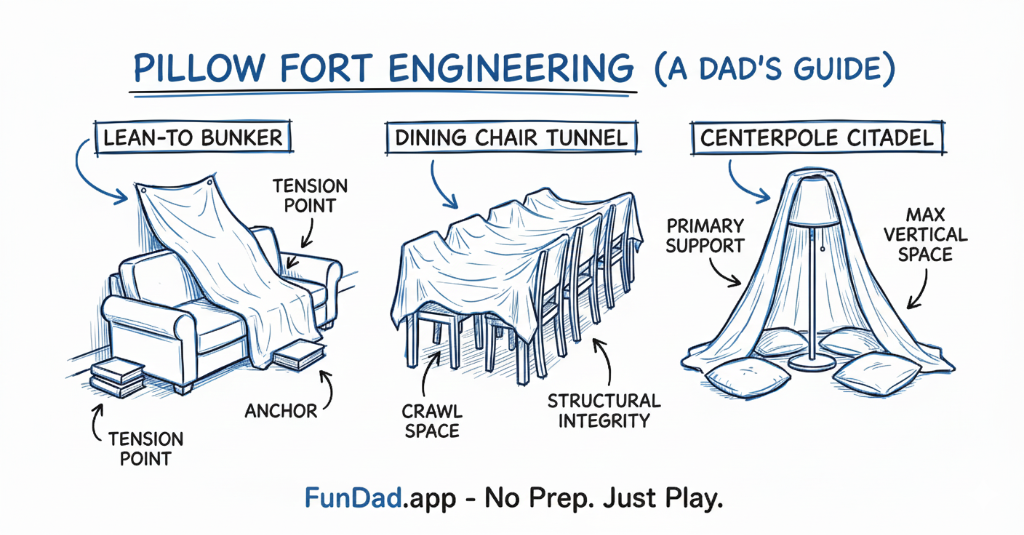
Here are three battle-tested best pillow fort designs, ranging from beginner to advanced, formatted just like the activities in the FunDad app.
Blueprint A: The “Lean-To” Bunker
The Gist: The fastest build for immediate deployment. Perfect for younger toddlers or quick rainy day pillow forts.
The Setup: You need the living room sofa and one large sheet.
How to Build: Tuck one long edge of the sheet firmly behind the back cushions of the sofa (or under them for maximum grip). Pull the sheet forward tautly and anchor the front corners to the floor using heavy books or shoes.
Pro Tip: The steeper the angle, the more headroom they have. Use taller stacks of books to raise the front entry.
Blueprint B: The Dining Chair Tunnel System
The Gist: Great for active kids who want to crawl and explore. Excellent for long hallways.
The Setup: 4 to 6 dining room chairs and 2-3 sheets.
How to Build: Line the chairs up in two rows, backs facing inward, leaving a crawl space in the middle. Drape sheets across the tops of the chair backs to create the tunnel roof. Use couch cushions to block the sides between the chair legs.
Pro Tip: Create a “turn” in the tunnel by angling the last two chairs for added mystery.
Blueprint C: The Centerpole Citadel
The Gist: This is advanced pillow fort engineering. It maximizes interior vertical space, perfect for storytelling in a fort or indoor camping with kids.
The Setup: A central support pole (a tall floor lamp turned off, a broom handled tied to a chair, or a very patient dad standing still), chairs for the perimeter, and your biggest sheets.
How to Build: Arrange chairs in a large circle. Place the centerpole in the middle. Drape the center of the sheet over the pole, and pull the corners out tightly to the surrounding chairs, anchoring them firmly. It should look like a circus tent.
Pro Tip: The “Centerpole” is the weak point. If using a broom, secure the base by sandwiching it tightly between two heavy couch cushions on the floor so it doesn’t slide out.
Phase 4: Fort Activation
You’ve built it. It’s standing. Now, what are some fun things to do inside a fort?
- The Reading Nook: toss in flashlights and pillows for quiet time.
- The Snack Depot: Serve a “camp lunch” (sandwiches cut into triangles) inside.
- The Defense of the Realm: You are the friendly dragon trying to get in; they must defend the walls with stuffed animals.
No Hard Hat Required
You don’t need an architecture degree to create magic in your living room. You just need to know how to wedge a dictionary onto a fitted sheet corner.
If you enjoyed these blueprints and want more instant activity ideas—whether you have high energy to build a citadel or just enough energy to lie on the floor as a “human anchor point”—check out FunDad. We use AI to scan your room and tell you exactly what you can build right now.
Download FunDad on the App Store and start engineering your next adventure.