We live in a hyper-visual world. Your child’s day is dominated by bright screens, colorful toys, and picture books. Their eyes are doing 90% of the work.
But there is a whole other way to perceive the world that often gets neglected: Touch.
When you remove sight from the equation, the brain has to work twice as hard to process information. It forces sensory integration activities to kick into high gear.
Enter the “Mystery Box.”
This is a classic mystery box game for kids that falls squarely under our Developmental Stealth Mode. To them, it feels like a hilarious game show challenge. To you, it is a sophisticated lesson in tactile sensory play, logical deduction, and vocabulary expansion.
Here is how to construct a DIY sensory box in five minutes and turn your kitchen table into a laboratory for toddler science observation.
The Setup: The Anti-High-Tech Console
You do not need to buy anything. This is the definition of cheap sensory toys.
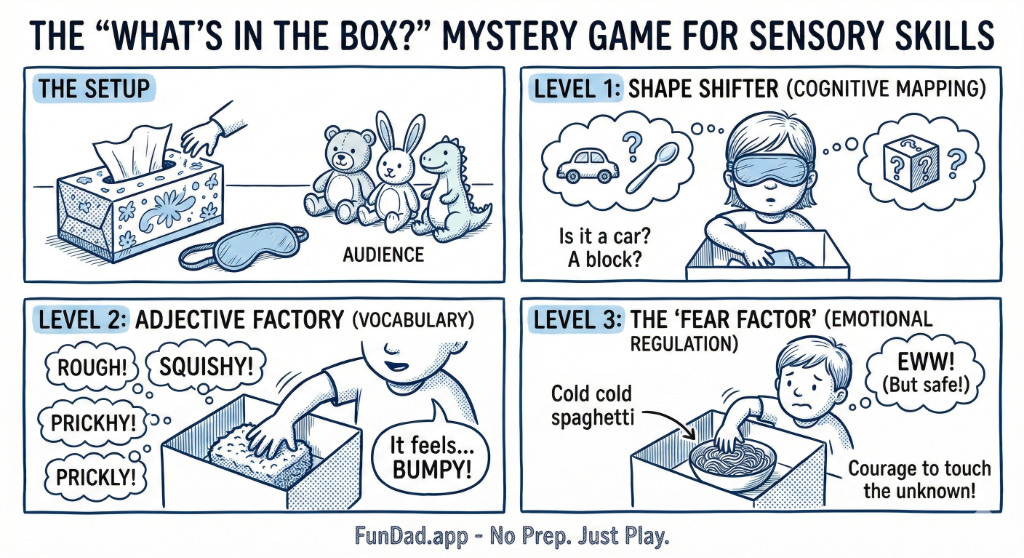
The Vessel: Grab an empty tissue box (the kind with the plastic slit on top is perfect). If you don’t have one, use a shoebox and cut a hole in the lid just big enough for a small hand.
The Blindfold (Optional): If you want to up the ante, add a blindfold. But usually, the box itself is enough to hide the secret.
The “Audience”: This works best with a crowd (mom, siblings, or even stuffed animals). The reaction of the audience adds to the drama.
Level 1: The Shape Shifter (Cognitive Mapping)
Start with guessing games for toddlers that build confidence.
The Objects: A toy car, a spoon, a building block, a tennis ball.
The Goal: Identifying objects by touch.
The Science: Their brain has to take the tactile signal from their fingertips (“it’s round,” “it’s metal,” “it has wheels”) and match it against their mental library of images. This connects the visual cortex with the somatosensory cortex. It’s a heavy lift for a developing brain!
Level 2: The Adjective Factory (Vocabulary Building)
Once they are good at guessing shapes, shift the focus to textures. This is a powerhouse for vocabulary building games.
The Objects: A piece of sandpaper, a cotton ball, a wet sponge, a pinecone, a feather.
The Rules: Don’t just ask “What is it?” Ask “What does it feel like?”
The Language Lesson: You are looking for specific language development describing textures.
“It feels rough.”
“It feels squishy.”
“It feels prickly.”
This turns a simple game into a lesson on adjectives that will help their reading and writing later on.
Level 3: The “Fear Factor” (Emotional Regulation)
Now we enter the realm of trust games for kids and curiosity building activities.
The Objects: Cold cooked spaghetti (worms?), peeled grapes (eyeballs?), a cup of Jell-O, or cold slime.
The Challenge: Putting your hand into a dark box to touch something wet requires courage. It triggers a mild “fight or flight” response.
The Win: When they touch it, realize it’s safe, and laugh, they are practicing emotional regulation. They are learning that the unknown isn’t always scary—sometimes it’s just funny.
Why It’s “Stealth” Development
Rainy day sensory play often feels like just killing time. But exploring objects blindfolded or hidden in a box builds sensory awareness games into your routine.
It teaches them to slow down. You can’t rush touch. You have to feel the edges, weigh the object in your palm, and think.
In a world of instant swipes and taps, this analog educational mystery game teaches patience and critical thinking.
So, go raid the junk drawer. Find a pinecone. Grab a tissue box. It’s time to play.
Download FunDad on the App Store. Point your camera at any object in your house, and we’ll tell you how to turn it into a sensory mystery or a developmental game instantly.
FunDad.app - No Prep. Just Play.